Originally published on angry robots, March 2005
About a month ago, I needed to make a simple map of the United States. So I copied the outline from a map I found on the internet, and (just as a challenge to myself) tried to fill in all the state names without any outside help.
Needless to say, I failed miserably. Half of the states were confused, misplaced or completely missing (especially in the Northeast, where tiny states are packed in like buckshot). But I was most surprised to find that I held two major misconceptions about Louisiana. For one thing, I thought it was right beside Florida (which it’s not); and for another, I thought it was one state inland (which it’s also not).
Louisiana is actually two states away from Florida (buffered by Alabama and Mississippi to the East), and it dangles its marshy feet right down into the Gulf of Mexico, where the Mississippi River, at its widest and deepest, spills into the ocean amidst a maze of marshes, bayous, peninsulas and rivers.
From a bird’s-eye view, New Orleans looks to be in the coolest possible spot for a city. Bordered by Lake Pontchartrain to the North (a 621 square mile lake that averages only 13ft in depth), and wrapped on all other sides by The Mississippi, almost half of the city’s area is water. The really interesting thing about New Orleans is that much of it actually sits several feet below sea level. In Harry Connick Jr.’s homage to his beloved home city, he calls it the “City Beneath the Sea”, and that seems entirely appropriate considering that one day, given the right storm conditions, it could be just that.
***
Louisiana Swamp Tours is about a half-hour outside New Orleans; a short drive over the Mississippi River Bridge, out Highway 90, past the blinking light (seriously, that was part of the directions), through Jean Lafitte National Historic Park and into the Bayou Barataria.
On the way to the dock, I noticed a sign that a local fisherman (or crazy person, who knows) had posted on his lawn proclaiming in bold black letters, “ANYONE WHO RIDES AN AIRBOAT IS CONTRIBUTING TO THE DESTRUCTION OF OUR WETLANDS”. There was a long, rambling explanation written underneath, but I didn’t pull over to read it. To be honest, the sign dampened the mood a bit (which I’m sure was the intent). But things brightened right back up once I saw that shiny silver fan boat – the words ‘Swamp King’ painted in Indiana Jones-type letters on its giant fins - bobbing like a cork alongside the dock, itching to show us brave adventurers a good time.
As it turns out, most of the area we visited is privately owned, and local airboat operators pay for the right to conduct tours thorough it. Crown Point (where the dock is) sits on the edge of a busy manmade canal, and most of the thin, murky waterways we buzz through are also manmade – dug in the 1950s to help facilitate oil drilling in the area.
We’d speed through some tiny channel for a minute or two, pull a ridiculous, splashy 90-degree turn into a small, hidden pocket of water and stop for a few minutes to take photos and learn a bit about the area from our guide, a young Cajun man with a thick-as-gumbo accent. He explained to us the difference between swamp, marsh and bayou, but I was too taken by the landscape to pay attention.
The area is thick with Cypress Tress cloaked in Spanish Moss. The leafless trees look dead (even though they’re not) and the mood in the swamp is a blend of creepiness and beauty. Wildflowers dot the mushy canal shores, and at one point we kept a dead-heat pace alongside a huge Egret as it took flight.
We came across some small fishing boats as we toured the maze of canals, but the only building we saw was a creepy old fishing shack that our guide claimed to have lived in, “until his old lady kick ‘im out.”
Of course, the real reason anyone goes on a swamp tour is to see alligators. At first, the alligator sightings were few and far between; but soon our guide was spotting the scaly bastards with startling precision from a hundred feet away. He’d jam on the brakes (well, not really – boats don’t have brakes) and pull up right alongside so that we could all snap our photos and ponder what it’s like to get chewed in half by one of those monsters.
Then, almost out of nowhere, our guide pulled out a baby alligator and started passing it around to anyone willing to hold it. Of course, being the brave soul I am, I took my turn holding the little dinosaur, and was honestly thrilled by it.
Eventually, we were all too wind-burned to take much more high-speed boating, so we headed back to Crown Point. All told, the tour lasted close to two hours and was worth every penny it cost. As our boat floated back up to the dock, I considered (but eventually decided against) going again.
***
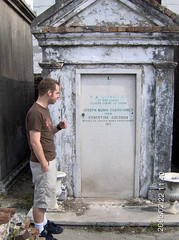
In New Orleans, they can’t bury their dead like we do. The water table is so high that if you buried a coffin, no matter how deep, it’d just be a matter of time before it popped right back up. So instead of flat, headstone-punctuated fields, New Orleans cemeteries are more like tiny cities for dead people.
St. Louis Cemetery 1 is the oldest existing cemetery in New Orleans, and it’s the closest major cemetery to the French Quarter: just a quick, traffic-dodging run across Rampart street, and out of the safety of the tourist district.
A high white concrete wall surrounds the relatively small cemetery (about the size of a city block), and walking through the narrow, single gate is like walking into another world. The traffic noise seems to magically disappear, and the eerie stillness prompts a reverent silence from everyone who wanders in.
One of the most striking things about St. Louis Cemetery is its uncanny resemblance to the rest of the French Quarter. Neighborhoods of tombs, in all imaginable sizes and shapes, are bunched together. Some are even surrounded by gorgeous ornate fences and gates, while others are topped by religious sculptures, decorated by elaborate facades and covered by shiny, engraved burial tablets. There are miniature bungalows, duplexes, mansions and even apartment buildings: as if the dead were still people - just people with less urgent need for space.
It felt like I might get lost among the 700-or-so tombs; some with shiny marble burial tablets and a fresh coat of whitewash, others little more than piles of loose bricks and rubble. The cemetery is home to infamous voodoo queen Marie Laveau, chess champion Paul Morphy, and a score of Jazz greats – though I didn’t know at the time which tomb belonged to whom and I didn’t investigate too thoroughly. Most of the tombs are meant to contain entire families, and some burial tablets list names that go back though generations to the beginning of the 1800s.
Exploring the cemetery was fun (in a morbid, melancholy way), but eventually the sun threatened to disappear, and I decided it was time to head back to Bourbon Street for another night of eating, drinking and strolling along the river, before the ghosts of New Orleans' past rose up to protest my trespass.

Subscribe to:
Post Comments (Atom)
No comments:
Post a Comment