Originally published on angry robots, March 2005
About a month ago, I needed to make a simple map of the United States. So I copied the outline from a map I found on the internet, and (just as a challenge to myself) tried to fill in all the state names without any outside help.
Needless to say, I failed miserably. Half of the states were confused, misplaced or completely missing (especially in the Northeast, where tiny states are packed in like buckshot). But I was most surprised to find that I held two major misconceptions about Louisiana. For one thing, I thought it was right beside Florida (which it’s not); and for another, I thought it was one state inland (which it’s also not).
Louisiana is actually two states away from Florida (buffered by Alabama and Mississippi to the East), and it dangles its marshy feet right down into the Gulf of Mexico, where the Mississippi River, at its widest and deepest, spills into the ocean amidst a maze of marshes, bayous, peninsulas and rivers.
From a bird’s-eye view, New Orleans looks to be in the coolest possible spot for a city. Bordered by Lake Pontchartrain to the North (a 621 square mile lake that averages only 13ft in depth), and wrapped on all other sides by The Mississippi, almost half of the city’s area is water. The really interesting thing about New Orleans is that much of it actually sits several feet below sea level. In Harry Connick Jr.’s homage to his beloved home city, he calls it the “City Beneath the Sea”, and that seems entirely appropriate considering that one day, given the right storm conditions, it could be just that.
***
Louisiana Swamp Tours is about a half-hour outside New Orleans; a short drive over the Mississippi River Bridge, out Highway 90, past the blinking light (seriously, that was part of the directions), through Jean Lafitte National Historic Park and into the Bayou Barataria.
On the way to the dock, I noticed a sign that a local fisherman (or crazy person, who knows) had posted on his lawn proclaiming in bold black letters, “ANYONE WHO RIDES AN AIRBOAT IS CONTRIBUTING TO THE DESTRUCTION OF OUR WETLANDS”. There was a long, rambling explanation written underneath, but I didn’t pull over to read it. To be honest, the sign dampened the mood a bit (which I’m sure was the intent). But things brightened right back up once I saw that shiny silver fan boat – the words ‘Swamp King’ painted in Indiana Jones-type letters on its giant fins - bobbing like a cork alongside the dock, itching to show us brave adventurers a good time.
As it turns out, most of the area we visited is privately owned, and local airboat operators pay for the right to conduct tours thorough it. Crown Point (where the dock is) sits on the edge of a busy manmade canal, and most of the thin, murky waterways we buzz through are also manmade – dug in the 1950s to help facilitate oil drilling in the area.
We’d speed through some tiny channel for a minute or two, pull a ridiculous, splashy 90-degree turn into a small, hidden pocket of water and stop for a few minutes to take photos and learn a bit about the area from our guide, a young Cajun man with a thick-as-gumbo accent. He explained to us the difference between swamp, marsh and bayou, but I was too taken by the landscape to pay attention.
The area is thick with Cypress Tress cloaked in Spanish Moss. The leafless trees look dead (even though they’re not) and the mood in the swamp is a blend of creepiness and beauty. Wildflowers dot the mushy canal shores, and at one point we kept a dead-heat pace alongside a huge Egret as it took flight.
We came across some small fishing boats as we toured the maze of canals, but the only building we saw was a creepy old fishing shack that our guide claimed to have lived in, “until his old lady kick ‘im out.”
Of course, the real reason anyone goes on a swamp tour is to see alligators. At first, the alligator sightings were few and far between; but soon our guide was spotting the scaly bastards with startling precision from a hundred feet away. He’d jam on the brakes (well, not really – boats don’t have brakes) and pull up right alongside so that we could all snap our photos and ponder what it’s like to get chewed in half by one of those monsters.
Then, almost out of nowhere, our guide pulled out a baby alligator and started passing it around to anyone willing to hold it. Of course, being the brave soul I am, I took my turn holding the little dinosaur, and was honestly thrilled by it.
Eventually, we were all too wind-burned to take much more high-speed boating, so we headed back to Crown Point. All told, the tour lasted close to two hours and was worth every penny it cost. As our boat floated back up to the dock, I considered (but eventually decided against) going again.
***
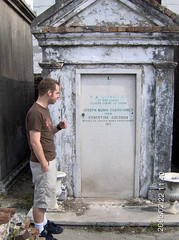
In New Orleans, they can’t bury their dead like we do. The water table is so high that if you buried a coffin, no matter how deep, it’d just be a matter of time before it popped right back up. So instead of flat, headstone-punctuated fields, New Orleans cemeteries are more like tiny cities for dead people.
St. Louis Cemetery 1 is the oldest existing cemetery in New Orleans, and it’s the closest major cemetery to the French Quarter: just a quick, traffic-dodging run across Rampart street, and out of the safety of the tourist district.
A high white concrete wall surrounds the relatively small cemetery (about the size of a city block), and walking through the narrow, single gate is like walking into another world. The traffic noise seems to magically disappear, and the eerie stillness prompts a reverent silence from everyone who wanders in.
One of the most striking things about St. Louis Cemetery is its uncanny resemblance to the rest of the French Quarter. Neighborhoods of tombs, in all imaginable sizes and shapes, are bunched together. Some are even surrounded by gorgeous ornate fences and gates, while others are topped by religious sculptures, decorated by elaborate facades and covered by shiny, engraved burial tablets. There are miniature bungalows, duplexes, mansions and even apartment buildings: as if the dead were still people - just people with less urgent need for space.
It felt like I might get lost among the 700-or-so tombs; some with shiny marble burial tablets and a fresh coat of whitewash, others little more than piles of loose bricks and rubble. The cemetery is home to infamous voodoo queen Marie Laveau, chess champion Paul Morphy, and a score of Jazz greats – though I didn’t know at the time which tomb belonged to whom and I didn’t investigate too thoroughly. Most of the tombs are meant to contain entire families, and some burial tablets list names that go back though generations to the beginning of the 1800s.
Exploring the cemetery was fun (in a morbid, melancholy way), but eventually the sun threatened to disappear, and I decided it was time to head back to Bourbon Street for another night of eating, drinking and strolling along the river, before the ghosts of New Orleans' past rose up to protest my trespass.
Monday, August 07, 2006

Sunday, August 06, 2006
Interview : Henry Rollins
Originally published on Bedlam Society, December 2002
Republished in Mondo Bizarre Magazine, Spring 2003
West Memphis Arkansas is a fucked up town. Because the story of the West Memphis Three is well documented elsewhere (like at http://www.wm3.org/) I'm just going to give you a basic rundown of the case:
On May 5th 1993, three young boys were brutally murdered in the Arkansas area known as "Robin Hood Hills". In a frantic search to find a scapegoat, local police concocted a story claiming that the murders were the result of "cult activity" in the area. Based entirely on the speculation of a local juvenile probation officer, police arrested three teenagers; Damien Echols, Jessie Misskelley and Jason Baldwin. Basically, the teens were convicted of the three murders despite a complete lack of evidence.
Since the boys' conviction in 1994, the case has been the subject of two HBO documentaries, both of which exposed incompetence and bias on the part of the local police. The fight to free the WM3 has become something of a crusade for many artists and celebrities including alternative icon Henry Rollins. Recently, Rollins conceived, organized and recorded a benefit record featuring popular artists singing songs by the legendary punk band Black Flag. Rollins took the time to chat with bedlam about the album, the case against the WM3 and the resurrection of Black Flag after 16 years.
Bedlam: Is the reason that you were so interested in doing this album because you see some of yourself in these three kids?
Henry: To a certain degree. Mainly though, what bugged me about the case was that due process was not served. You don't get thrown in jail for capitol murder, or even a parking ticket without proof. Well…where's the proof? They don't have any. That's just it. There's nothing that ties these boys to the crime. Let's say they did do it; you still can't put them in jail with no evidence. I don't want them to get out on a technicality; I believe they're innocent. I'm not just saying, "ha ha, you need more proof". Motherfucker, you need proof! Not more proof, some. None is not good enough, and that's what they have is none.
That's what initially got me, but that's just the surface of it. Then you get into it. You go to the websites, you start reading and you find that there's a lot more information to be had, so I went and pursued it. Then you find out that there's this whole other life going on around this trial. You find out that the judge and the members of law enforcement in this town have a really bad corruption problem. There's a lot more going on than just these three heavy metal kids in jail. So, I got really concerned. Also, just mad. I thought "not on my watch". I took it personally. If you get away with this and I don't do anything then I'm okaying that somehow. I can't do that. I'm not trying to be righteous or anything I just saw that and wondered, who am I if I just say "oh that sucks" and get into my BMW and go tooling down the road.
Bedlam: I remember watching the first documentary and thinking that it wasn't real.
Henry: Yeah. I thought these actors would all take a bow at the end and go "boo! That's what can happen when the American justice system breaks down", but it's real. Some of the court stuff seemed so TV movie of the week. Things like "I don't know how you do it over in Berkley California".
Bedlam: Yeah, exactly. I don't even necessarily mean that the story seems unreal, but some of the characters are just unbelievable. The stepfather for example.
Henry: Yeah…it's like he's a character actor. It's incredible. It's like the Beatles. It's like this perfect bunch of circumstances has this incredible yield. You have what I feel is a very corrupt way of doing things in that town. That stepfather is just a trip. They broke the mold. The most generic thing in the whole story is the three kids in prison. They're just three, hapless Arkansas residents. They have dumb hairdos and they like heavy metal. Okay, but that doesn't get you arrested.
Bedlam: I never thought of it that way, but I guess the kids do seem like the most normal people involved in this whole thing.
Henry: You see interviews with them, and you know they're innocent. Guilty people are always covering and ducking. These guys are just looking at the camera and saying "what the fuck?" It's pretty easy to tell the difference between a guilty person and an innocent person. When you see how these kids are all arrogant in court you think, well yeah. That's kind of how you are when you're sixteen and you're innocent. You go in there with an attitude. If you didn't do it, of course you don't have any fear. You just trust that the justice system will have you out of there by the afternoon. It's only when you actually did something that you're like "oh shit".
Bedlam: But at the same time, this is just one case that is getting a lot of publicity….
Henry: Sure. There are innocent people in jail in every county in America, I know that, but you can't free them all. This is just one case that moved me. Mainly it was the HBO documentaries that got me interested. I saw them, they grabbed me, I got involved. I'm not saying it's the only case of this. Maybe some good can come of this if we can pull back and start looking at the rest of these questionable cases. Innocent people do go to jail, and maybe we should start checking that out more often.
Bedlam: That's kind of what I was getting at when I asked if this had something to do with your own personal experience. Historically, you make no bones about not liking the police.
Henry: Well…I don't like bad cops. I've got no problem with a cop doing his job, but I think beating an old woman to death with a tree branch is against the law. You don't pay me to enforce the law, you pay the cop guy, so he should take care of that problem. The painter paints your house, the roof dude fixes the roof, the cop gets the bad guys. The problem is that when the cops are the bad guys, what are you going to do? That's my problem. Who do you call when a cop is fucking with you…the cops? It's like the ultimate cat and mouse game. That to me is not a fair fight. That's the problem I have with cops, but it's only the bad ones. I know a lot of cops and they're like "don't hate me man". I don't! If you're not a racist, asshole cop I'm on your side. If you're falsely accusing people and planting evidence on them…fuck you. Get out of my country.
Bedlam: Do you think this album is going to bring a lot more attention to the case?
Henry: It'll bring some. I mean, I have never overestimated music's limited potential on getting something done.
Bedlam: Sure, but you found out about it by watching the documentary right? Everybody has to finds out about it somehow.
Henry: Well, the packaging has a lot of information in it. Maybe someone will go to the website, write a letter to the governor, or get involved somehow. That's what I'm hoping for. An awareness factor.
Bedlam: It's pretty safe to say that this record, even outside the context of being a benefit record, is something that a lot of people would want to have.
Henry: Yes. It is a damn good record. We did it. We made a really good record. I listen to it as just a fan of rock (or whatever) and I realize that besides the benefit part of it, we made a really smokin' record. I'm hoping that people hear it and want to have it because they like the music. What I tried to do was to make, for the artists involved and the buyers, the most tantalizing possible thing. I tried to get singers who have pretty heavy tours to pause and sing on our record for free. What would be my aphrodisiac to lead them to the studio? Black Flag music. As a buyer, Black Flag music (as cool as it is) was never that well recorded. The records leave one wanting production-wise. I thought it would be great to make, basically, a Black Flag greatest hits album with contemporary singers and production that brings the music to the nth degree.
Bedlam: I don't know though…I think a lot of people like the production of the old stuff. The rawness is an important element, don't you think?
Henry: No, I don't.
Bedlam: Really?
Henry: Man, I think it sucks. I was there when we'd run out of money and have to mix the whole thing in one night.
Bedlam: Listening to the new album, what struck me is that everything is really true to the original songs. A lot of these kinds of albums really mess with the songs.
Henry: We didn't fuck with it. The music's good enough. We just tried to hang on and get through it. I think my guys delivered big time.
Bedlam: So all the music was recorded beforehand and the singers were just brought in as they were available?
Henry: Yeah. For the basic tracks we did 11 songs the first day and 13 songs the second day. Then in two days we did all of the guitar overdubs. In four days of studio work, all the music was done. We don't fuck around. The singers would either come into the studio (if they could get to LA) or parts were sent to them wherever they were. Neil from Clutch did his at home, Iggy did his thing in Miami, Ice-T did his thing in New York, Chuck D did his thing in New York, Hank III did his in Nashville…wherever they were.
Bedlam: Who was the biggest deal for you to get on the record?
Henry: Me personally…as a fan? Chuck D. Even though he only does one line, I'm just SO into Chuck D.
Bedlam: Me too. I have to say though; I was a little disappointed that he's only at the very beginning of the song.
Henry: Well…that's all I wanted. I wanted that righteous booming baritone to call out West Memphis. Like "motherfucker, your number is up because Chuck D is here!" That's the vibe. The song was all done, and one night I thought "oh god, Chuck D!" I just heard it. I knew he had to be on this record, so I wrote him this two page pleading email. I just told him what we were doing and said "you gotta be on this thing". Normally I do not lean on that guy for favors, but he came through. The next day he emailed me back and said "of course, can I do it by Friday?" Friday he sent me a CD-R of him doing that line 24 different ways. He gave us different inflections and pauses just so that we as producers could have an option. He's a pro.
Bedlam: Well, it's definitely a great way to kick off the album.
Henry: Yeah. It's like ringing the alarm, you know? Also having Iggy Pop was big. Black Flag was always a band very enamored with The Stooges. I don't know how much Greg Ginn knows about who's on the record yet, but I can't wait to hear what he thinks of Iggy Pop singing a Greg Ginn song. He's gonna be a pretty happy dude. Iggy whoops ass on that song. Iggy is a huge hero of mine, so having him on board means a lot to me. I'm overjoyed that those guys both came through. Talk about not even in the same genre. They just came out of different elements and hopped on board.
Bedlam: Was it kind of bittersweet to go back to these songs after so long?
Henry: Well, it was weird going back. I haven't played these records in a long time, but it was cool to see how well the songs still worked. The guys in the band all grew up on this music, and in a way I did too. We were all just standing there at the end of the second day of practice and we were looking at each other going "God damn I'm worn out." Songs like this really kick your ass. We became fans all over again in a different way. I've been out of that band for so long, and I didn't write any of that music, so I'm kind of just back to fan status. For me it was like this cool two weeks of karaoke. I marveled at the compact, intense energy that these songs have. They really are efficient. It's like "here is fifty seconds…what can we do in fifty seconds?" Well, Revenge. That's a dense 50 seconds.
Bedlam: You mentioned that Greg had known beforehand about you doing the album…
Henry: Yeah. I don't know how much you know about the more boring parts of the music business, but with music publishing what you usually get on a record is what's called a 12 song publishing cap. It's where we put like 15 songs on the record and you get publishing for 12. We just agree on it. Otherwise you have to keep jacking up the price of the record. To pay publishing on 24 songs, there would be no money for the kids who we're doing the benefit for. We had to call Greg and get his blessing on a 12 song publishing cap. He's the publisher, so it's up to him. If he said no and made us pay on 24 songs, this record would have been a very different situation. It would have barely made a profit, and it would have added $2 to the retail. I wrote him, explained what we were doing and asked for the 12 song cap, please. He said, "you got it". He was so cool about it.
Bedlam: What about the rest of the people who have been in the band? I mean, you got Keith back, you got Kira and Chuck back…how did they feel about the whole thing?
Henry: They were really into it. Keith was the first guy I called. I got a room to practice, a studio to record, and a band to play with. Okay, so now I need singers. I'm in, but who else? Gotta call Keith Morris. Without him, we don't have a record as far as I'm concerned. Keith is a really wonderful guy, and he said yes. I told him "that was a relief", and he said "come on, you knew I'd do it." I told him "no I didn't, but as far as I'm concerned, this record has no integrity if you're not on it." So, he came aboard. Listen to that vocal! I mean, forget it! He fucking kills that thing. He's fucking 50 man! He just walks in and hit this vocal and we're all like "oh my god!"
Bedlam: Was a lot of the stuff one take?
Henry: Yeah. Or two takes. These people came really prepared.
Bedlam: What's to prevent you from taking this thing on the road in some form?
Henry: Well, it's not like I don't want to. I mean, we were having so much fun playing these songs. Before we recorded, we were doing this as a 24 song set in 4 song blocks. Sometimes we were like "let's go find a club tonight and play" because things just feel really good. Yeah, I'd love to do a handful of shows and give the money to the kids. I think people would love it. Basically, the only thing in my way is that I've got a lot of work right now. My boys are busy making their own record, and I've got a bunch of other stuff going on. There's no way I could go out on the road.
Bedlam: You got a few new movies coming out soon don't you?
Henry: Yeah. I've got a lot of film-type stuff coming up. Right now I'm in the middle of Bad Boys 2 with Will Smith and Martin Lawrence. I did another film earlier this year, I have a TV show called Full Metal Challenge on TLC, I just did an episode of the Drew Carey show…I'm doing a lot of that stuff now. Between tours I just kind of freelance. I always have a pile of stuff to do here at the office. I just finished a lyrics book that came out, and we're finishing up an internet CD release for the Rollins Band. I'm also always going out on auditions for voice-overs, movies and TV. Right now I seem to be getting a lot of parts, so until the next tour starts in January, that's what I'll be doing.
Bedlam: Is it a talking tour coming up?
Henry: Yeah. 80 shows. We're going everywhere. North America, Europe, Australia and maybe more.
Bedlam: I don't understand how (during your talking shows) you can talk for three hours and not stop. Not take a drink, not sit down…nothing.
Henry: It's just what I do. I like it up there. I've been in front of people performing for over half my life, and after a while it just becomes you. I don't know what I would do without that. Those tours are hard. I mean, you've seen me before, so multiply that by 50 and get back to me. Some nights you walk out and you don't know if you can do it, but then you go out there and it's the best show of that month.
Bedlam: Is all the danger gone out of touring now?
Henry: It certainly is a smoother, more predictable ride than it used to be. It's no longer a wild journey. It's more like one pro-gig to the next. In the Black Flag days (and early Rollins Band) it was like "we're gonna go on tour I HOPE, and we're gonna pull off these shows I THINK." Now it's just business as usual. That's cool though. I don't want to have to hope for a P.A.
Bedlam: I'm actually a little surprised that you don't like doing interviews. You seem to me like the kind of guy who enjoys talking to people.
Henry: Well, I don't mind them, but I mean…it's Saturday! I've got press until 3:00, and if you saw my week…it's just been relentless. This has been okay because all the journalists really like the record and they all dig the cause. When it's one of my own records it's a trickier deal. They're just like, "justify your existence" basically. "What's the difference between this record and your last record?" Let's see…keyboards, saxophone, backing vocals….you have to kind of defend your product. This is different because there isn't much to say about this record. Why did you do it? Because we wanted to help out. Why Black Flag music? It's the ultimate protest music and it'll definitely make people pause. The record is really good. If you don't like it, it's just because you don't like it. It's not because we didn't play the songs well and it's not that it wasn't produced well. The production is great, the playing is ridiculous and the singers are scorching. If you don't like it, it's just not your trip, but it's not like we put out a cheesy product.
Bedlam: But at the same time, does the press mean anything to you? I mean, I've read letters you've written to magazines responding to articles about you.
Henry: The older I get, the less it does. When you're younger, you're more precious with stuff. Someone doesn't like your record, so you get all hot and bothered. Well, if you really like what you do, do you really care what he thinks? Well, no. If you get bent out of shape about it then you must be insecure about what you did. I'm not insecure about the records I make. I make really good records. I'm not bragging, It's just fact. I don't put 'em out if they're not good.
I know what a music journalist is at this point. It's a guy (with about eight to eleven pounds of body fat that he doesn't need on him) who gets records for free via jiffy-packs in the mail. His breadth and scope of music is nothing compared to mine. He doesn't do what I do, nor could he, so I take him with a grain.
To me, a music critic should be conversant in Mozart, Leadbelly and Jane's Addiction as well as Sum 41. Sometime you read a review that says a certain song is great and you hear it and find out it's an MC5 rip-off note for note…and you didn't catch it! No critic busted Pearl Jam on "even flow". It's Voodoo Child! They're not bad people, they just like Jimi Hendrix. It's Voodoo Child with a different vocal melody. Next time you hear the song, check it out. They did that and no one called them on it. It's because music critics these days don't have the back-knowledge. I meet music journalists whose first record purchase was Metallica's black album. That's cool, but did you go back and check out Fats Waller, Miles Davis, Duke Ellington, Cab Calloway and Janis Joplin? No? Then what the fuck are you doing at your job? In fact…I should have your job. "I listen to everything." Oh, you do? What's your favorite Pigmy music? Me…Imbuti. It's more melodic than Aka and Baka Pigmy music. I have all these records. I do the research and I buy the bootlegs. I am a fan. What I find most of the time are music journalists who are just doing it before fall term starts. Record reviews are more about the reviewer.
We just put out a live album (The Only Way To Know For Sure). I wrote the press release for it, and it said "dear music critic, here is the sum of two nights in Chicago. It's a band playing, it's mixed very well and there are mistakes but they're left in. If you don't like it, it says something about you…not us. Write what you want and show me what you're made of." It's thoroughly confrontational. The reason it's called "The Only Way To Know For Sure" is that I don't give a fuck what your studio record sounds like. I know how they're making them now. I wanna see what you can do live. That's when it's real sex. I mean, Macy Gray had two 24-track machines; do you think they could get one good album out of that chick? She can't even make her way through a song.
Bedlam: I've always thought that a truly great band can get up on stage and do a great show in just jeans and t-shirts. If it doesn't work without a gimmick…you aren't a good band.
Henry: Yeah, exactly.
Interview : The International Noise Conspiracy
Originally Published on Bedlam Society, October 2002
Living in the shadow of your past successes can be a difficult thing. For the last three years, The International Noise Conspiracy have been trying to shake the stigma of being "the band with the guy from Refused in it". Through hard work and constant touring, they are not only succeeding, but they are playing to the mainstream audience that Refused could never have dreamed of reaching.
Their high energy garage/blues/soul tunes and explosive live shows are exciting audiences all across the globe...and with the support of MTV and other mainstream media outlets, they might very well succeed at bringing socialism to the masses (even if it's only in spirit). Whether you like it or not, the International Noise Conspiracy are fast becoming the biggest band in political rock.
I recently met up with Guitarist Lars Stromberg in Toronto to talk about politics, their new album and the stale old rock n' roll myth.
Bedlam: I hate to start off being contrary, but it says in your bio that you "aim to shake up the very foundation of the bourgeois myth of the rock band", but anyone who's seen your show knows that you are very much a rock band in a lot of ways.
Lars: Oh definitely, but I guess we wouldn't be able to shake up the foundation of that myth if we didn't deal with where the "rock myth" is mostly established…which is at a rock show. I guess what we mean by that is that we want to bring in new elements to the traditional concept of a rock show. There's the whole communication aspect and the whole political aspect. We want to bring in something that people who are used to a traditional rock show aren't really used to. We want to bring the politics into a new context which hopefully can make somewhat of a difference to the sort of stale rock audience. A lot of people just go to shows because it's what they do. They know how to behave and they know what's expected from them as an audience. We want to make people realize that it's as much up to them to entertain themselves as it is up to us to entertain them. Hopefully we can tear down the barriers a little bit.
Bedlam: Is it in any way a kind of satire of the traditional "rock show"?
Lars: To some extent, yeah. I personally can't do like…a rock kick without thinking that it's a bit funny. I don't really take myself all that seriously when I do stuff like that, but at the same time, since I'm used to playing in punk bands I'm just used to sort of going off on stage and putting a lot of energy into it. It's sort of an outlet, but at the same time it's a bit of a parody. There's a lot of little details of things that we do that we just stole from other bands or other people that we use to entertain ourselves.
Bedlam: Where do think you guys fit in to the current "rock scene"?
Lars: Hopefully we can fit in everywhere. We play music that is definitely more accessible to people than what we used to play. All of our previous bands were fast paced punk / hardcore bands and I guess the most noticeable is Denis' old band Refused. That type of music didn't really appeal to a lot of people. You had to be involved in a sort of subculture or clique to appreciate it. Hopefully we can play music that the punks can like, because they see where we're coming from and they see what we're talking about, and we can play music that my dad can like because he sees the traces of rock history. We're not really interested in belonging to a specific scene. We're lucky because we're one of the few bands that can play a punk squat and then play…like a big German mainstream festival the next day. I guess with our punk history we're in a unique position. It seems more interesting than just saying "We're punks so we play to punk kids".
Bedlam: Obviously the idea is to reach as large an audience as possible with your message, but do you think it's possible to achieve a certain level of success without co-opting your original ideals as a band?
Lars: No, not at all. It's impossible to live your socialist ideas if you live in a capitalist society. We've made so many compromises from the day we started out. We started out playing small shows and putting out our own records and that's how we were used to doing it. We were approached by a bunch of labels and we turned them down, but then we realized that to do what we set out to do which was to play music that was more accessible to people, we had to use the channels that were offered to us to reach out to more people. That was definitely a compromise. We had to sort of succumb to a bigger label which happened to be burning heart, which still isn't a big label, but I guess a lot of punk kids would call them a major label. It's all a matter of definition I guess, but we figured that with them we wouldn't have to compromise too much.
We didn't want to go with like…Virgin or Dreamworks because we would have just been swallowed and spat out right away. There are always compromises, but hopefully you don't have to compromise too much of what you believe in because you still want to maintain some honesty in what you do and in the goals you set for yourself. We realize that the ideas that we're talking about are way too important to be kept underground…to be kept a secret. Those ideas should be mainstream. They should be on MTV and in magazines and pretty much everywhere.
Bedlam: Do you find yourself having to defend your politics a lot? Even more so since September?
Lars: Yeah, but how we present ourselves hasn't really changed at all. I guess what we have been given is a chance to use our tools of analysis in a different way than we are used to because of this new situation. Everyone has had to deal with things in a different way. We haven't really had to prove ourselves that much, but we have been given the opportunity to talk about a lot of different things now. I think it's really important that we're not afraid to talk about all of this. We can't be afraid to discuss it and try to figure out why. We can't get caught up in this whole self censorship deal that's happening to a big extent in the states where their taking songs off the radio and taking away all the pictures of the twin towers. It's important that we don't do what's been done so many times in history like try to push it away and bring it into a collective state of forgetting it, like what happened with the Berlin wall. There's not a lot of the Berlin wall left which is pretty sad because it should be there so we can see what it was and so we can discuss it. A lot of the politics that were going on a long time ago in east and west Berlin are still very much in action in east and west Germany because East Germany haven't really been allowed to catch up. The economic structures are still there even though the wall is gone. It seems like they just tore it down so everyone thinks things are good, but they're not. Everything won't get back to normal just because we choose to forget certain cultural objects.
Bedlam: Last time you were here was when the free trade summit was going on in Quebec and you had all kinds of radical literature confiscated at the border. That's something that I would think would never happen in Canada where we have "freedom of speech", but it obviously does happen. What's the level of that kind of censorship in Europe?
Lars: We haven't really had any trouble of that kind in Europe…ever. I think that's because, especially now with the European union and the whole sort of "build a fortress of Europe" idea, if you're inside of that it's very easy to move from point A to point B within that territory. I think if we were a band from further east, like from a country that isn't in the union, and we had those books with us it would have been virtually impossible for us to get in there. It's a lot like it is here at the Canadian / American border. If you're an outsider it's really hard to get across. Within Europe it's easy because they want to create a new superpower to match themselves with the East Asian block and the US. It's going to be really hard for smaller countries that aren't in the union to carry out trade and thing like that. They'll be forced to apply to be part of the union because they can't really exist as an independent state if they don't.
Bedlam: Just to move on to the music for a minute, the new record is a progression from the last album. There are some new elements and styles (like the soul backup vocals). Was that more to keep you guys interested as a band or to keep the music interesting for the audience?
Lars: I think it was a bit of both. We obviously don't want to repeat what we have done already. That's why the 7inch collection sounds different from Survival Sickness which in turn sound different than this new album. The songs sound different and we wanted to present ourselves in sort of a "whole new package" so to speak. It was definitely a conscious effort to change the production and to change the instrumentation and to bring in more influences and more people who could play on it. It was definitely an effort to move away from the previous albums. A lot of it for us is that we don't want to be bored with what we do, but we also want to continue and try to surprise people.
Bedlam: How do the songs come together? Is there a primary person who drives the writing?
Lars: No. We always practice with all of us there. I don't think we've practiced ever without everyone in the band being in the room, which I think is the best way of doing it. Someone comes up with an idea from playing at home, but we take that one little idea (which could be a guitar riff or a bassline or something) and we jam around that for however long it takes to form it into a structure. Everyone in the band utilizes their instruments and for that matter Denis utilizes his voice too. He just sort of plays around with words to see what words will fit in. Then we just sort of sit down and discuss what the song actually should be about. We always do everything together when it comes to songwriting. It's much more interesting to do it that way. I don't think that individually we would be very good songwriters. I think the sum is much stronger than just one individual would be.
Bedlam: Do you find that generally you have a collective vision of what a song should be?
Lars: No, not at all. If you have, say, one bassline you can look at it in a number of different ways. That's where the conflict in songwriting comes about. We all have different visions of what we want. I guess the end product is never really what the vision was. Also we always like to play new stuff live, so we change things a bit for the live version and we change things again for the studio version and so on. We never really reach the final version of a song. In a lot of ways a song is pretty much dead once you've created it. We don't want to keep rehashing the same thing over and over.
Bedlam: How much input does the producer have?
Lars: A LOT.
Bedlam: As far as the overall sound or the actual music?
Lars: A little bit of both. We're fortunate enough to have met a producer with the same sort of vision as us, but with a different way of getting there. A producer is really important because he's the only person that can picture everything as a whole. We're always very surprised when it all comes together. When the song is done and mixed, you finally see what purpose banging a drumstick against a steel wagon or something actually has.
Bedlam: This is your first Canadian date and the Fort Erie / Buffalo border is notorious for giving bands a hard time. Is it generally tough for you guys to get through?
Lars: No, not really. Last time they confiscated those books and they made us go back to the states and ship all our merchandise to the next US show. We were there for like 4 hours. They were just being general assholes about it, but today was pretty easy. They didn't search the van or anything, but we're going back into the states so they still have a lot of time to fuck with us.
It's kind of easy for us because we have all the legit papers so we don't have to fake recording contracts or anything like a lot of bands do.
Bedlam: So you don't have to be like, "We're just going over to shop…or something."
Lars: Yeah....like "Oh there are guitars back there? I didn't even notice."
Living in the shadow of your past successes can be a difficult thing. For the last three years, The International Noise Conspiracy have been trying to shake the stigma of being "the band with the guy from Refused in it". Through hard work and constant touring, they are not only succeeding, but they are playing to the mainstream audience that Refused could never have dreamed of reaching.
Their high energy garage/blues/soul tunes and explosive live shows are exciting audiences all across the globe...and with the support of MTV and other mainstream media outlets, they might very well succeed at bringing socialism to the masses (even if it's only in spirit). Whether you like it or not, the International Noise Conspiracy are fast becoming the biggest band in political rock.
I recently met up with Guitarist Lars Stromberg in Toronto to talk about politics, their new album and the stale old rock n' roll myth.
Bedlam: I hate to start off being contrary, but it says in your bio that you "aim to shake up the very foundation of the bourgeois myth of the rock band", but anyone who's seen your show knows that you are very much a rock band in a lot of ways.
Lars: Oh definitely, but I guess we wouldn't be able to shake up the foundation of that myth if we didn't deal with where the "rock myth" is mostly established…which is at a rock show. I guess what we mean by that is that we want to bring in new elements to the traditional concept of a rock show. There's the whole communication aspect and the whole political aspect. We want to bring in something that people who are used to a traditional rock show aren't really used to. We want to bring the politics into a new context which hopefully can make somewhat of a difference to the sort of stale rock audience. A lot of people just go to shows because it's what they do. They know how to behave and they know what's expected from them as an audience. We want to make people realize that it's as much up to them to entertain themselves as it is up to us to entertain them. Hopefully we can tear down the barriers a little bit.
Bedlam: Is it in any way a kind of satire of the traditional "rock show"?
Lars: To some extent, yeah. I personally can't do like…a rock kick without thinking that it's a bit funny. I don't really take myself all that seriously when I do stuff like that, but at the same time, since I'm used to playing in punk bands I'm just used to sort of going off on stage and putting a lot of energy into it. It's sort of an outlet, but at the same time it's a bit of a parody. There's a lot of little details of things that we do that we just stole from other bands or other people that we use to entertain ourselves.
Bedlam: Where do think you guys fit in to the current "rock scene"?
Lars: Hopefully we can fit in everywhere. We play music that is definitely more accessible to people than what we used to play. All of our previous bands were fast paced punk / hardcore bands and I guess the most noticeable is Denis' old band Refused. That type of music didn't really appeal to a lot of people. You had to be involved in a sort of subculture or clique to appreciate it. Hopefully we can play music that the punks can like, because they see where we're coming from and they see what we're talking about, and we can play music that my dad can like because he sees the traces of rock history. We're not really interested in belonging to a specific scene. We're lucky because we're one of the few bands that can play a punk squat and then play…like a big German mainstream festival the next day. I guess with our punk history we're in a unique position. It seems more interesting than just saying "We're punks so we play to punk kids".
Bedlam: Obviously the idea is to reach as large an audience as possible with your message, but do you think it's possible to achieve a certain level of success without co-opting your original ideals as a band?
Lars: No, not at all. It's impossible to live your socialist ideas if you live in a capitalist society. We've made so many compromises from the day we started out. We started out playing small shows and putting out our own records and that's how we were used to doing it. We were approached by a bunch of labels and we turned them down, but then we realized that to do what we set out to do which was to play music that was more accessible to people, we had to use the channels that were offered to us to reach out to more people. That was definitely a compromise. We had to sort of succumb to a bigger label which happened to be burning heart, which still isn't a big label, but I guess a lot of punk kids would call them a major label. It's all a matter of definition I guess, but we figured that with them we wouldn't have to compromise too much.
We didn't want to go with like…Virgin or Dreamworks because we would have just been swallowed and spat out right away. There are always compromises, but hopefully you don't have to compromise too much of what you believe in because you still want to maintain some honesty in what you do and in the goals you set for yourself. We realize that the ideas that we're talking about are way too important to be kept underground…to be kept a secret. Those ideas should be mainstream. They should be on MTV and in magazines and pretty much everywhere.
Bedlam: Do you find yourself having to defend your politics a lot? Even more so since September?
Lars: Yeah, but how we present ourselves hasn't really changed at all. I guess what we have been given is a chance to use our tools of analysis in a different way than we are used to because of this new situation. Everyone has had to deal with things in a different way. We haven't really had to prove ourselves that much, but we have been given the opportunity to talk about a lot of different things now. I think it's really important that we're not afraid to talk about all of this. We can't be afraid to discuss it and try to figure out why. We can't get caught up in this whole self censorship deal that's happening to a big extent in the states where their taking songs off the radio and taking away all the pictures of the twin towers. It's important that we don't do what's been done so many times in history like try to push it away and bring it into a collective state of forgetting it, like what happened with the Berlin wall. There's not a lot of the Berlin wall left which is pretty sad because it should be there so we can see what it was and so we can discuss it. A lot of the politics that were going on a long time ago in east and west Berlin are still very much in action in east and west Germany because East Germany haven't really been allowed to catch up. The economic structures are still there even though the wall is gone. It seems like they just tore it down so everyone thinks things are good, but they're not. Everything won't get back to normal just because we choose to forget certain cultural objects.
Bedlam: Last time you were here was when the free trade summit was going on in Quebec and you had all kinds of radical literature confiscated at the border. That's something that I would think would never happen in Canada where we have "freedom of speech", but it obviously does happen. What's the level of that kind of censorship in Europe?
Lars: We haven't really had any trouble of that kind in Europe…ever. I think that's because, especially now with the European union and the whole sort of "build a fortress of Europe" idea, if you're inside of that it's very easy to move from point A to point B within that territory. I think if we were a band from further east, like from a country that isn't in the union, and we had those books with us it would have been virtually impossible for us to get in there. It's a lot like it is here at the Canadian / American border. If you're an outsider it's really hard to get across. Within Europe it's easy because they want to create a new superpower to match themselves with the East Asian block and the US. It's going to be really hard for smaller countries that aren't in the union to carry out trade and thing like that. They'll be forced to apply to be part of the union because they can't really exist as an independent state if they don't.
Bedlam: Just to move on to the music for a minute, the new record is a progression from the last album. There are some new elements and styles (like the soul backup vocals). Was that more to keep you guys interested as a band or to keep the music interesting for the audience?
Lars: I think it was a bit of both. We obviously don't want to repeat what we have done already. That's why the 7inch collection sounds different from Survival Sickness which in turn sound different than this new album. The songs sound different and we wanted to present ourselves in sort of a "whole new package" so to speak. It was definitely a conscious effort to change the production and to change the instrumentation and to bring in more influences and more people who could play on it. It was definitely an effort to move away from the previous albums. A lot of it for us is that we don't want to be bored with what we do, but we also want to continue and try to surprise people.
Bedlam: How do the songs come together? Is there a primary person who drives the writing?
Lars: No. We always practice with all of us there. I don't think we've practiced ever without everyone in the band being in the room, which I think is the best way of doing it. Someone comes up with an idea from playing at home, but we take that one little idea (which could be a guitar riff or a bassline or something) and we jam around that for however long it takes to form it into a structure. Everyone in the band utilizes their instruments and for that matter Denis utilizes his voice too. He just sort of plays around with words to see what words will fit in. Then we just sort of sit down and discuss what the song actually should be about. We always do everything together when it comes to songwriting. It's much more interesting to do it that way. I don't think that individually we would be very good songwriters. I think the sum is much stronger than just one individual would be.
Bedlam: Do you find that generally you have a collective vision of what a song should be?
Lars: No, not at all. If you have, say, one bassline you can look at it in a number of different ways. That's where the conflict in songwriting comes about. We all have different visions of what we want. I guess the end product is never really what the vision was. Also we always like to play new stuff live, so we change things a bit for the live version and we change things again for the studio version and so on. We never really reach the final version of a song. In a lot of ways a song is pretty much dead once you've created it. We don't want to keep rehashing the same thing over and over.
Bedlam: How much input does the producer have?
Lars: A LOT.
Bedlam: As far as the overall sound or the actual music?
Lars: A little bit of both. We're fortunate enough to have met a producer with the same sort of vision as us, but with a different way of getting there. A producer is really important because he's the only person that can picture everything as a whole. We're always very surprised when it all comes together. When the song is done and mixed, you finally see what purpose banging a drumstick against a steel wagon or something actually has.
Bedlam: This is your first Canadian date and the Fort Erie / Buffalo border is notorious for giving bands a hard time. Is it generally tough for you guys to get through?
Lars: No, not really. Last time they confiscated those books and they made us go back to the states and ship all our merchandise to the next US show. We were there for like 4 hours. They were just being general assholes about it, but today was pretty easy. They didn't search the van or anything, but we're going back into the states so they still have a lot of time to fuck with us.
It's kind of easy for us because we have all the legit papers so we don't have to fake recording contracts or anything like a lot of bands do.
Bedlam: So you don't have to be like, "We're just going over to shop…or something."
Lars: Yeah....like "Oh there are guitars back there? I didn't even notice."
An Explanation
I know, I know - what's with having a million different blogs?
To be honest, I only opened a blogger account to comment on other people's blogs, but I've decided to start collecting some older features and travelogues I've written, as well as publishing some short fiction I've had on the go that nobody will ever want to read.
Sounds good, huh? So there you go. If you expect anything really interesting, never come back.
To be honest, I only opened a blogger account to comment on other people's blogs, but I've decided to start collecting some older features and travelogues I've written, as well as publishing some short fiction I've had on the go that nobody will ever want to read.
Sounds good, huh? So there you go. If you expect anything really interesting, never come back.
Subscribe to:
Comments (Atom)